
Throughout the first five modules, my inquiry question has remained centered on how non-Indigenous educators can respectfully and authentically incorporate Indigenous perspectives into everyday classroom practice. As I explored inquiry-based learning and the Spiral of Inquiry this week, I began to see how inquiry can provide a meaningful framework for putting many of the concepts from previous modules into action.
One of my biggest takeaways from the first five modules is that meaningful learning happens through relationships, reflection, experience, storytelling, and connection to the land. The First Peoples Principles of Learning reinforced that learning is holistic, experiential, relational, and connected to identity, community, and place. Throughout the course, I have reflected on the importance of land-based learning, witnessing, talking circles, storytelling, Indigenous self-determination, cultural safety, and the need to move beyond tokenistic inclusion of Indigenous perspectives.
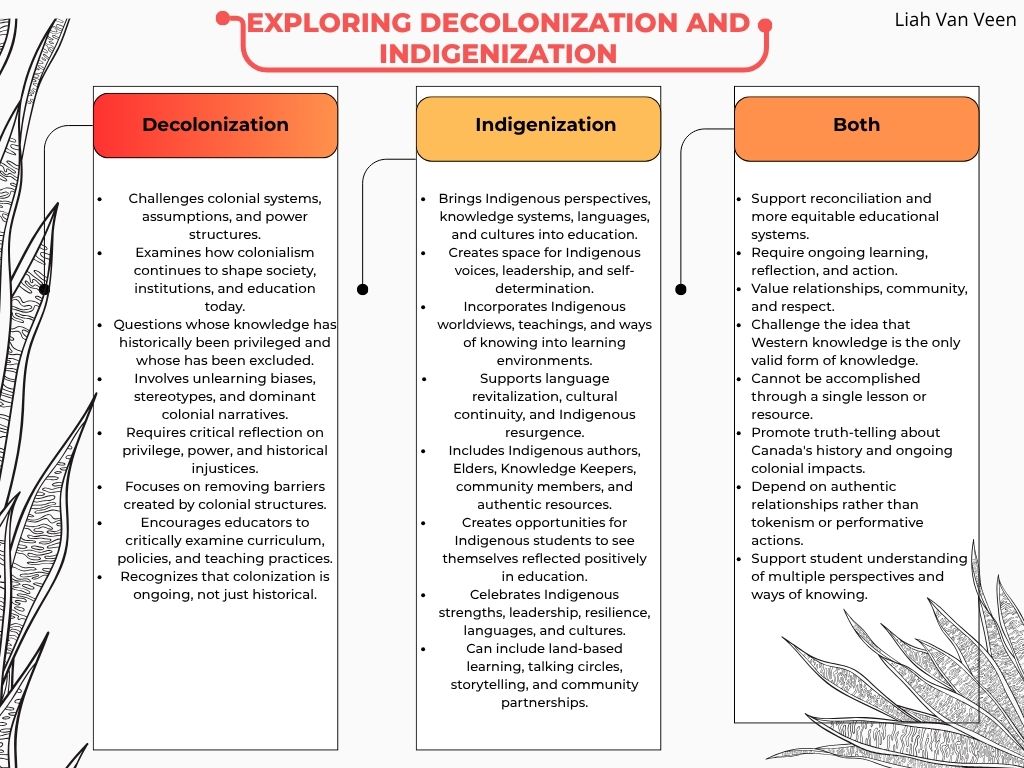
Exploring decolonization and Indigenization helped deepen my understanding that these concepts are related but distinct. Decolonization involves examining and challenging colonial systems, assumptions, and power structures that continue to influence education today. Indigenization focuses on meaningfully incorporating Indigenous perspectives, knowledge systems, languages, cultures, and ways of knowing into educational spaces. One of my biggest takeaways was that neither process can be accomplished through a single lesson or resource. Instead, they require ongoing reflection, relationship-building, and a commitment to creating learning environments where Indigenous voices, histories, and perspectives are valued, respected, and reflected throughout everyday practice.
Learning about authentic Indigenous resources reinforced the importance of critically examining who created a resource, whose voices are represented, and whether Indigenous perspectives are presented accurately and respectfully. Authentic resources should prioritize Indigenous authors, illustrators, Knowledge Keepers, and communities while avoiding stereotypes, tokenism, and pan-Indigenous representations. This learning encouraged me to be more intentional when selecting classroom materials and to seek out resources that highlight Indigenous Peoples as diverse, contemporary, and thriving. It also reinforced the value of using trusted Indigenous publishers and organizations, such as Strong Nations, when building classroom collections and planning learning experiences.
This week, I realized that inquiry-based learning naturally aligns with many Indigenous pedagogical approaches. Rather than positioning the teacher as the sole holder of knowledge, inquiry encourages curiosity, questioning, observation, collaboration, and reflection. Students become active participants in their learning rather than passive recipients of information. This connects strongly to the idea of learning through experience, participation, and relationships that was emphasized in Potlatch as Pedagogy and throughout many of the course resources.
The Spiral of Inquiry also challenged me to think differently about teaching. Instead of beginning with what I want students to know, the process begins by listening to learners and asking what is happening for them. This aligns closely with Indigenous approaches that value student voice, community knowledge, relationships, and multiple ways of knowing. It reminded me that meaningful learning often begins with curiosity rather than answers.
As I was developing my inquiry project, Whose Stories Does the Land Tell?, I could see many connections between inquiry learning and Indigenous pedagogies. Students are encouraged to ask questions, investigate Indigenous perspectives, engage with stories and community knowledge, reflect on their learning, and share their understanding in ways that are personally meaningful. Rather than learning about Indigenous Peoples through isolated lessons, students learn through inquiry, reflection, relationship-building, and authentic exploration.
One area where my thinking has continued to grow is around my role as an educator. Earlier in the course, I often worried about making mistakes when incorporating Indigenous perspectives into my teaching. While I still recognize the importance of approaching this work with humility and respect, I am beginning to understand that inquiry learning does not require me to have all the answers. Instead, it requires me to be a learner alongside my students, to ask questions, seek out Indigenous voices and resources, and remain open to ongoing growth and reflection.
Ultimately, the first six modules have reinforced that reconciliation is not a destination or a checklist. It is an ongoing process of learning, unlearning, listening, reflecting, and taking action. Inquiry-based learning provides a powerful framework for supporting this work because it encourages curiosity, critical thinking, relationship-building, and authentic engagement with Indigenous perspectives, communities, and ways of knowing.
Connections to My Practice
As an educator, I hope to create inquiry-rich classrooms where students have opportunities to explore questions connected to land, identity, community, history, and responsibility. I want students to learn through observation, storytelling, discussion, outdoor experiences, community connections, and reflection rather than relying solely on textbooks and worksheets.
Moving forward, I will continue using the First Peoples Principles of Learning as a foundation for inquiry projects by creating learning experiences that are:
- Connected to land and place
- Grounded in relationships and community
- Reflective and experiential
- Inclusive of Indigenous voices and perspectives
- Focused on student curiosity and agency
- Supportive of multiple ways of demonstrating learning
Through this course, I have come to understand that inquiry is not simply a teaching strategy. When approached thoughtfully, it can become a pathway toward more authentic, respectful, and meaningful learning for all students. It also provides an opportunity to continue answering the inquiry question that has guided my learning throughout these modules: How can non-Indigenous educators respectfully and authentically incorporate Indigenous perspectives into everyday classroom practice?
Question I Still Have
How can educators build authentic relationships with local Indigenous communities and Knowledge Keepers while ensuring that inquiry projects remain respectful, reciprocal, and community-informed rather than relying solely on classroom resources?
Through exploring Rocky Mountain School District No. 6’s Elders/Knowledge Holders Educators’ Handbook, I learned that relationship-building, reciprocity, and consultation are foundational when working with Elders, Knowledge Keepers, and Indigenous communities. The handbook provides valuable guidance and identifies local partners, including local Nations, Indigenous Education Support Workers, and Métis organizations. While these resources provide a strong starting point, I continue to wonder how educators can move beyond initial connections and develop long-term, authentic relationships that support meaningful learning for students while respecting community protocols and priorities.
This question continues to guide my learning and reminds me that reconciliation, inquiry, and culturally responsive teaching are all ongoing journeys rather than finished destinations. As a life long learner and educator, I hope to continue learning from local Indigenous communities, Elders, Knowledge Keepers, Friendship Centres, and Indigenous Education Support Workers so that Indigenous perspectives are shared authentically and respectfully within my classroom. Ultimately, I believe that strong relationships and community partnerships are essential to creating learning experiences that are authentic, culturally responsive, and grounded in local knowledge systems.
Sorry, but comments are not enabled on this site.